
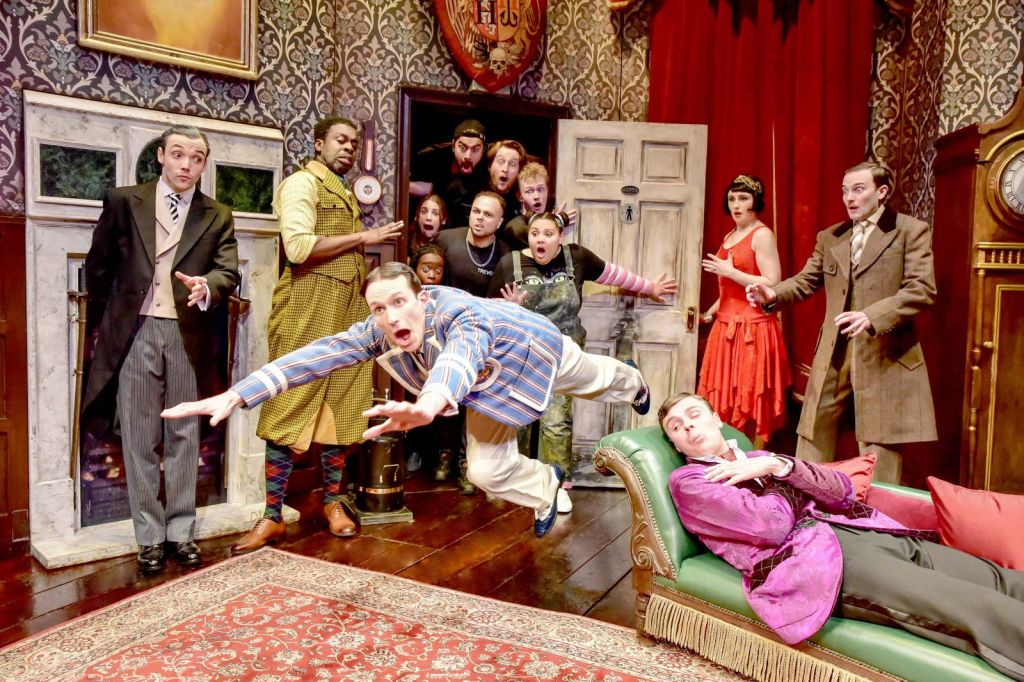
Critiquing a West End show – especially one as accomplished as The Play That Goes Wrong – definitely gives me “guy on couch criticizing Olympic athletes” vibes. (“HA! You call that a high jump? More like a high CHUMP!”) Nonetheless, here we go.
The Play The Goes Wrong is a slapstick farce by Mischief Theatre (specifically written by Henry Lewis, Jonathan Layer, and Henry Shields) that originally opened in 2012, and has since been played all over the world, resulting in a couple of spin-offs, as well as a TV Show, and is to this day the “longest running comedy of the West End” (their words). The version I saw, directed by Mark Bell, played at the Duchess Theatre, and I loved it! I found it riotously funny! …except the parts that weren’t.
A quick Google search made me find that – while critics seemed rather unanimous in their positive reviews – audiences were more mixed, some even giving 1-star reviews and talking about walking out! Now it is to be expected – with any successful piece of art – that there will be a fair share of backlash, naysayers, folks who don’t like something simply because others do. But the average score of 3.8 stars felt particularly low to me for this level of entertainment.
Now, granted, these were Google Reviews, so the people leaving them were most likely weirdos. But even weirdos’ opinions are important in the Theatre! Thus, in the spirit of fairness, I’ve made it my mission to try and separate the wheat from the chaff, see if there is any basis to these negative reviews, and see what might have potentially gone wrong in The Play That Goes Wrong.
Synopsis:
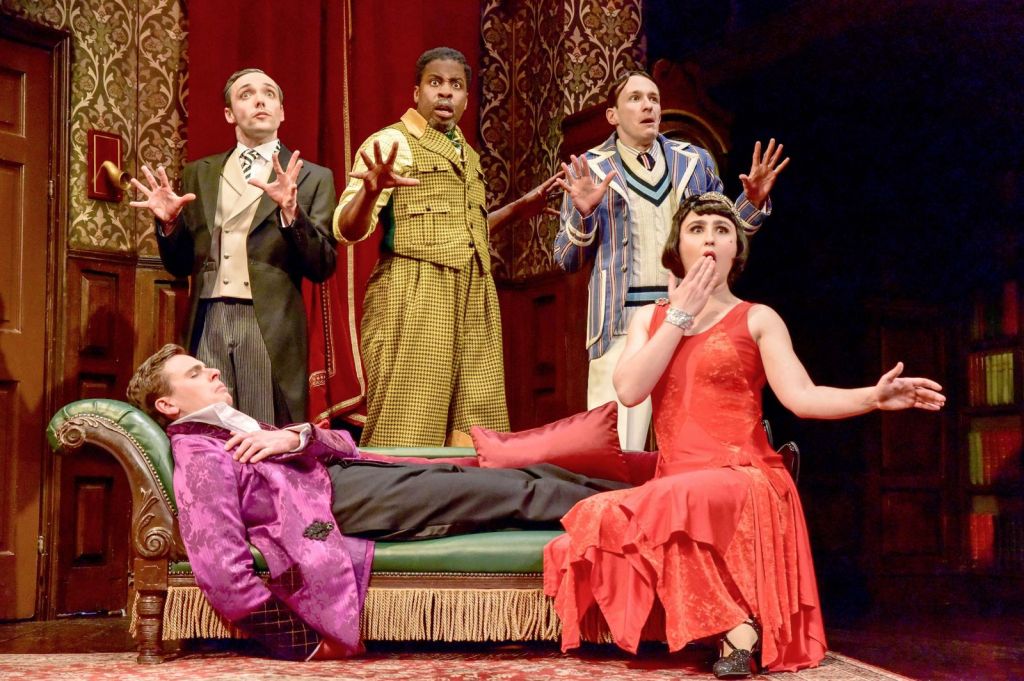
The Cornley Polytechnic Drama Society presents Murder at Flaversham Manor, a thrilling Agatha-Christie-like whodunit set in the 1920s. After a few announcements from the director – who also plays the inspector (Daniel Cech-Lucas) – it doesn’t take long for things to start falling apart – figuratively and literally. Not only do the self-important actors and incompetent tech crew keep screwing up their jobs, the set itself seems to rise up against them. The Gods of Theatre simply do not want this show to happen apparently, and yet it does. Doggedly, the cast ignores every issue that happens on stage and tries to just cross that finish line, often with hilarious results.
Unfortunately, that’s about all the plot I can tell you, because really that’s all that happens. I couldn’t tell you the play-within-the-play’s story because, obviously, it takes a backseat. The show’s main focus is the slapstick, the gags, the what-I-pedantically-would-call lazzi. (You might want to look that word up, I’m coming back to it later.) I can’t remember the order of the gags, because I was too busy enjoying the show.
I can tell you the twist ending, but only because the actor playing the corpse (Luke Dayhill) enters too soon! Repeatedly! (My guy! Your entrance is at the END of the show! At the very least, WAIT FOR THE INTERMISSION!!!!) I can tell you there’s an actress who gets knocked out on stage (Lucy Doyle), so they get a tech person to read in for her (Iona fraser), only for the tech person to enjoy the role a little too much; that there’s the stage manager who is more focused on finding his Duran Duran CD than in the show (Hisham Abdel Razek); there’s the actor who is constantly winking at the audience, even in dramatic scenes (Ross Virgo); the one who writes difficult words on his hand, only to STILL mispronounce them (Keith Ramsay); the obviously Shakespeare-trained actor (Rolan Bell) who suffers the entire show only to have a meltdown at the end (“WHY DO WE EVEN HAVE A POTTED PLANT IN THIS CORNER??? IT MAKES NO SENSE!!!”); that all of them are dressed in Cluedo style costumes (the characters names might as well have been Colonel Mustard, Lady Crimson, Dr. Blue, etc); and that by the end, the stage is completely and utterly destroyed. But I don’t know if any of that is actually plot.
So… take from that what you will.

Analysis:
Let’s start with the good. It is funny. The performances are crisp; the ensemble is well united; the comedic timing is worthy of a chef’s kiss. It is impressive. The (actual) tech crew is phenomenal; they must do incredible work in the background for timing all the set catastrophes just right. The actors as well, they have to hit very specific marks, sometimes down to the centimetre, at breakneck speeds, and they make it seem easy. Needless to say, a lot of work needs to go into such a spectacular failure. It is also rather innovative. While not the first of its genre (see Durang’s The Actor’s Nightmare), it is – as far as I can tell – the first one on such a large scale, full-length, making a home for itself on the West End. Even inside the play are small meta-theatrical games that are actually quite sophisticated. For example:
The moment that struck me was when the inspector character (Daniel Cech-Lucas) fails to find a vital prop – which has been misplaced – and breaks down crying, repeating in a sad, whimpery voice “a ledger, a ledger, a ledger.” Now we as the audience see it, but he doesn’t. Anyway, he curls up into a ball, completely defeated and quietly sobs, and then… nothing. There’s a rather pathetic, uncomfortable silence. Finally, someone in the audience shouts “It’s under the couch!” and the actor does a complete 180 and spits out venomously: “I’m doing a scene! Can’t you see that? You’re not supposed to talk during a scene!” and proceeds to have a whole improvised bit where he insults the audience and, of course, the audience laughs at him for it.
Now, audience participation isn’t anything new, but to have a moment where the play won’t move forward until the audience participates is actually kind of ballsy. At least, to me it is. I’ve never seen that, either on a West End show or otherwise. Usually, when you think ‘audience participation’, you think: the performer going up to the audience, trying to figure out who’s ‘cool,’ having a quick chat with them, and that’s it. Maybe a callback later in the show. But to basically stop the show and put the ball in the audience’s court… It’s subtle, it’s new, it’s engaging, it makes you feel something! It gently, playfully forces the audience into new territory, of not being just an observer. Of reminding them: “Hey! You’re a part of this!” It invites: “Join in on the chaos!” Which is, in my opinion, what good Theatre is meant to do.
I remember just before this moment, I was getting annoyed at some people whispering behind me. Then the audience mamber shouted “under the couch!”, the actor exploded to the audience and said “This is a serious play! The audience must be silent! You’re not supposed to talk during a play!” and I felt like the butt of the joke. I felt personally attacked, but in a good way. I felt represented, the person who takes plays probably a little too seriously. (And I stand by it: don’t talk during a play!)

So, yeah, for all these reasons, I say this show is a solid 5 star show. Must see, yadda yadda, shilling for the Duchess.
Now, let’s see what the haters have to say about it:
“[T]he worst show in the West End (…)” 1 Star
“Boring, repetitive, banal ‘humour’ – possibly attempting to emulate silent, slapstick B&W comedies (and succeeding in THAT at least – if nothing else!)” 1 Star
“It was like Basil Fawlty, the chuckle brothers, mr bean and mr tumble paraded about shouting at each other and knocking in to things on stage for 2 very long hours.” 1 Star
“The humour never quite bursts through the fact that it’s all scripted. Bearing in mind it’s a play within a play, the funniest moments were when the actors broke the fourth wall and engaged with the audience & spontaneously ad-libbed, but those moments were rare / scripted. . . . It’s a middling sitcom, not bleeding-edge stand-up; the humour is contained throughout.” 2 Stars
“[T]his show and its humour is certainly not for everyone. It’s incredibly slap stick – think Charlie Chaplin style – lots of repeated jokes but the worse part is how drawn out the jokes were.” 1 Star
“[A]re the people who are laughing in the Audience actors as half of the time they laughed before the actual punchline.” 1 Star
“Those long pauses? Please you are not amateurs! Biggest waste of £350.” 1 Star
“I found the humour very PG, not particularly clever and low cheap gags to get a laugh, more than a few fell flat on their faces.” 1 Star
“If you read the reviews you might conclude that this show is a little like Marmite… You either love it or hate it.” 3 Stars
Okay, I believe that’s enough. First where I disagree:
First off, comedy doesn’t have to be “biting edge stand-up” or R-rated. Though there’s nothing wrong with enjoying biting satire or dark humor, one should never lose – in my opinion – that innocence that makes slipping on a banana peel funny. That one person compared the show to Charlie Chaplin – perhaps THE most timeless comedy icon – as if it was a bad thing! Same with Basil Fawlty and Mr. Bean! (I don’t know the others.) But good lord! “It’s like Mr. Bean, Basil Fawlty and Charlie Chaplin put together!” That sounds awesome! Not for a killjoy academy graduate, surely, but for the rest of us absolutely! Next, yes, it is scripted, the show doesn’t actually go wrong. If you can’t suspend your disbelief, then don’t see the show. Finally, as one of those who was laughing before the punchlines (and funnily enough I am an actor… think I can charge them for my services?): Often the comedy comes from the anticipation of what’s about to go wrong. An important source of comedy is when the audience feels smarter than the characters. We see them heading for a train crash + them not seeing it = laughter. Also, for the ticket prices thing, yes it’s expensive, but it’s a West End show, aren’t they all? And comedy is subjective so, if you see a West End comedy, it’s always gonna be a gamble in that sense. (But yes, that would hurt, I imagine.)

Now for the stuff I agree with:
The jokes do repeat a lot, and that can be hit or miss. The nature of the lazzi (told you I’d come back to it) is such that if something is funny on stage, you keep doing it until the audience is sick of it. This can be a long time sometimes. We’ve all experienced that one joke that gets funnier and funnier each time you tell it, or with callbacks, etc. The problem is, this tool is meant to be used in improv theatre, where you can gauge the audience’s reaction and change at a moment’s notice. If it’s scripted, and the joke doesn’t land, and you keep coming back to it, then you’re kind of up shit creek without a paddle.
Example: During the show, the whiskey bottle gets emptied on stage. The problem is the characters keep referring to the drinks they are having. The butler grabs the first thing he can get, something like paint thinner, and fills up the glasses. The actors, unaware, take a drink, do a great spit-take, and punchline: “Oh, that’s good scotch.” Audience laughs, money earned.
The problem becomes when they do the EXACT SAME JOKE like several times throughout the show. It’s fine to come back to it, but you need variation. The only variation I could find is that, at one point (out of 8) the spit-take was kind of different (where, instead of spitting, it just poured out of his mouth). The worst thing about this to me is that it kind of goes against the story they’re telling. I don’t care how incompetent of an actor you are, if you drink bleach once, you’re not doing it again! You’re gonna keep an eye on whoever is serving you the drinks and making sure it doesn’t go in your mouth. And so, much funnier I think it would have been, if instead of drinking the whatever-it-was, and doing spit-takes, they found more and more elaborate ways of making the audience believe they have drunk the drink without actually doing it. Pouring it down their shirts/pants, trying to distract the audience so they can throw it out somewhere, whatever. Doing everything you can to avoid drinking it. This sets up a callback where, when something finally DOES go RIGHT, they let their guard down, take a drink, and spit-take. It becomes funny again.
Disclaimer: like I said, comedy is subjective. There are people that did laugh at the spit-takes, but I wasn’t one of them. I did laugh however every time someone got knocked out on stage. Maybe someone had the opposite reaction, loving the spit-takes, hating the knock-outs. I say they should’ve looked for more variation, but maybe it’s a question of audience sensibility, I don’t know.
Next, “those long pauses.” Yes, there are many slow takes. I’m very torn about this one., because on the one hand, they’re expertly done. Something goes wrong and everybody freezes, like deer caught in spotlight. It’s very real, very human (if you’ve ever been on stage and had something go wrong, you know) and very funny. The problem, like with the spit-take, is that they see how well it works and decide to put them all over the place, cheapening the gag.
There are a few moments (two if memory serves) where the phone rings, and it’s for someone who is keeping a bunch of scenery from falling down. There is a huge silence because, what a predicament he is in! How will he get out of this one. Like before, sure, the first one works, but the second time around, it has to be a bit snappier, because we have seen this set-up.
Now one might argue that the reason this silent beat takes so long is because the actor is doing, practically speaking, an acrobatic act, throwing obligation upon obligation on someone who already has their hands full. Having some circus routines or examples of virtuosity in your show is no problem, actually it’s great! (I haven’t really touched upon it, but there is quite a bit of circus/vaudeville in this show, which I love!) The problem is, a virtuosity that slows the rhythm of your show – a rhythm that is meant to be break-neck speed – is not a virtuosity… It’s a guy interrupting your show to do something that’s ‘neat.’

Conclusion:
So what’s the synthesis of all this? I guess that one person put it best, it is love or hate. Though arguably there is much more love than hate, and it is well earned! Like I said at the beginning, my criticism here feels a bit “guy on couch criticizing historical figure.” (“For God’s sake Schindler! YOU COULD’VE DONE SO MUCH MORE!” he shouts, in his underwear, his mouth full of potato chips.) All this to say, I do not mean to take away from this amazing performance. I just enjoy deconstructing comedic material. The funnier it is, the more in depth I go, and the harsher I may seem.
I certainly hope I haven’t come off as too mean, nor given it too much blind praise. I certainly recommend it, as I find it nothing short of hilarious. But I guess I can’t say it’s a flawless piece of work either. (Then again what is?)

 The Nest
Leave a comment